
Preparing a perfume for the German market: what documents and roles are needed before sale?
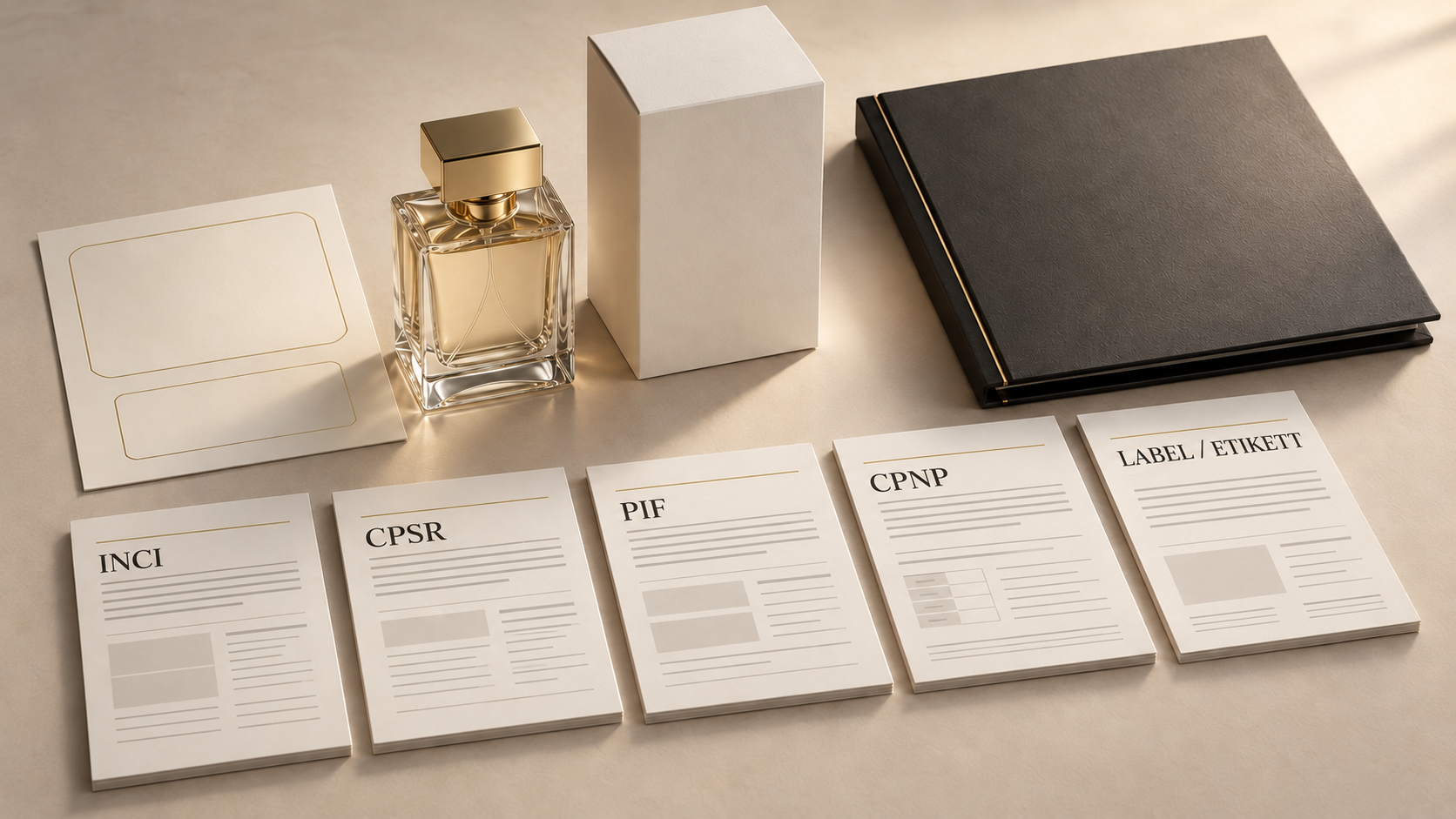
A finished fragrance and ordered packaging do not yet make a perfume ready for sale. Before the first sale, responsibilities, safety documentation, product information, notifications and labelling must align.
For a planned launch in Germany, the central question is therefore: Who must create, review, notify and retain each item, and what evidence shows that the task is genuinely complete?
The following overview is a working tool. It is not legal advice and does not replace a project-specific review. It helps a brand assign tasks early instead of searching for missing information across several parties shortly before launch.
Begin with the target market and product role
EU cosmetics law provides a common framework for cosmetic products in the European Union. Market readiness still depends on the target market. Language, national enforcement practice, packaging law, distribution and any further country-specific requirements must match the intended sales territory.
This first version considers a launch in Germany. Additional EU markets are not automatically covered by a German packaging and language review. Record:
- the countries in which the product will first be offered
- who legally places it on the market there
- the name or brand under which it appears
- the languages needed on the product and packaging
- who sells directly and which retailers or distributors are involved
Only then can a reliable responsibility matrix be prepared.
Name the responsible person first
Under the EU Cosmetics Regulation, a cosmetic product may be placed on the market only when a natural or legal person established in the EU is designated as the responsible person. This person ensures that the applicable obligations for the specific product are met.
The role must not be confused with general project coordination. Olfaktorische Welten can obtain documents, organise information and coordinate specialist partners. The legal role of responsible person is nevertheless assigned explicitly for each project. Under the confirmed working model, it may be held by the client or a suitable specialist partner; Olfaktorische Welten is not presented as the responsible person by default.
Record the responsible person’s full legal name and address in the project file. Also identify who on that side gives technical approvals and where the Product Information File will be made available.
Complete the safety assessment and CPSR before sale
Before a product is placed on the market, it must be safety-assessed on the basis of the relevant information. The result is documented in the Cosmetic Product Safety Report (CPSR). The assessment is prepared by an appropriately qualified professional.
Depending on the product, the review may consider the formula and raw-material information, exposure, physical and chemical characteristics, stability, microbiological aspects, packaging compatibility and intended use. The qualified safety assessor decides which evidence is actually required for the specific formula and product configuration.
Olfaktorische Welten coordinates the documents and handovers required for this process. The safety assessment itself is prepared by a specialist partner. This does not constitute certification by Olfaktorische Welten or automatic approval of every product variant originally requested.
Treat the Product Information File as a complete dossier
The Product Information File (PIF) is not a single certificate. It brings together the required information about the product and includes the CPSR. The responsible person must keep it available to the competent authorities.
Olfaktorische Welten can coordinate compilation of the PIF. The working matrix should nevertheless track each contribution separately:
- Who supplies the final formula and raw-material information?
- Which version of the safety assessment applies?
- Which manufacturing method and statement on good manufacturing practice belong in the file?
- Which evidence supports the effects claimed for the product?
- Which packaging and label version is the approved one?
- Who keeps the complete PIF available, and at which address?
A folder containing many files is not automatically a complete PIF. Version status, responsibility and consistency with the product actually sold are decisive.
Notify through CPNP, but do not describe it as approval
Before the product is placed on the market, the required product information is submitted through the Cosmetic Products Notification Portal (CPNP). The responsible person is accountable for the notification and may work with designated users or service providers under the applicable arrangements.
In a project with Olfaktorische Welten, the notification may be carried out by the client, a specialist partner or Olfaktorische Welten acting on instruction, depending on the role model. The responsibility is named explicitly in the matrix.
CPNP notification is not regulatory approval and not a quality seal. It does not replace the safety assessment, PIF or correct labelling. Once a product has been properly notified in CPNP, no additional national product notification is required within the EU. Other national obligations, including language and packaging requirements, remain unaffected.
Align INCI, allergens and labelling with the final formula
The labelling of a cosmetic product must match the final formula and product configuration. Depending on the product, this includes:
- the name and address of the responsible person
- nominal content
- minimum durability or period after opening, where applicable
- particular precautions
- batch identification
- product function where it is not obvious
- the list of ingredients using the applicable nomenclature
Expanded requirements for the individual labelling of fragrance allergens have applied since 31 July 2026 to newly placed products. Which substances must be declared separately in the ingredient list depends on the final composition and the applicable thresholds. Products placed on the market before that date have a separate transition period until 31 July 2028. New projects work to the current requirements.
Olfaktorische Welten obtains the relevant information from fragrance, raw-material and production partners and compiles or reviews INCI and labelling information within the project process. Final consistency and legal responsibility remain with the responsible person.
Classify safety data sheets correctly
Safety data sheets are important working documents for fragrance compounds, alcohol and other raw materials. They may also provide information relevant to classification, storage and transport. This does not mean that every finished perfume requires a consumer-facing safety data sheet.
The article therefore separates three levels:
- Raw-material and fragrance documentation obtained from suppliers.
- Safety assessment and product documentation under cosmetics law.
- Project-specific requirements for storage, shipping and dangerous-goods transport.
The documents required at the third level are reviewed according to the formula, alcohol content, packaging, quantity and transport route.
Packaging law: LUCID is only the first step
Anyone placing packaged products on the German market for the first time must determine which company is the producer for packaging-law purposes. Under the rules applicable since August 2026, the commissioning brand company is generally considered the producer for own-brand or licensed-brand products. An exception may apply to microenterprises where the supplier is established in the same EU Member State. The classification must therefore be made for the specific contractual and supply model.
For sales, grouped and shipping packaging subject to system participation, three tasks generally belong together:
- registration in the LUCID Packaging Register
- paid participation of the relevant packaging quantities with a system operator
- reporting packaging quantities to the system and in LUCID
These duties lie with the producer that is legally obliged. The client can perform them directly. Olfaktorische Welten makes the responsibility visible in the project but does not automatically take it on as its own service.
Smaller companies should not confuse a small quantity with the absence of an obligation. Under current German law, producers with less than ten tonnes of packaging subject to system participation in the previous year are covered by a simplified annual data-reporting rule. The project must still establish whether the packaging is subject to system participation and which company must report it.
Responsibility and document matrix
Scroll sideways to read the table.
| Topic | Accountable party | Preparation or contribution | Evidence before sale | Project status |
|---|---|---|---|---|
| Responsible person | client or specialist partner, assigned for the project | written acceptance of the role and contact details | designated EU person with address | open / confirmed |
| CPSR/safety assessment | responsible person | qualified specialist partner; Olfaktorische Welten coordinates documents | final assessment for the final formula and packaging | open / in progress / final |
| PIF | responsible person keeps it available | Olfaktorische Welten coordinates; partners and client contribute | complete, versioned product file | open / complete |
| CPNP | responsible person | client, specialist partner or Olfaktorische Welten acting on instruction | confirmed notification of the final product version | open / notified |
| INCI and labelling | responsible person | Olfaktorische Welten compiles or reviews information; partners supply data | approved print and product version | open / reviewed / approved |
| Production and batch handover | to be assigned in the project | production and filling partners | agreed specification and batch logic | open / confirmed |
| LUCID/system participation | legally obliged producer | client or other identified party | registration, system agreement and quantity report | open / evidenced |
| Countries and languages | responsible person/client | specialist review by target market | approved market and language list | open / confirmed |
Add a named person and date to every open point. “The partner will handle it” is not a sufficient assignment until the partner, outcome and evidence have been specified.
What does not belong in this dossier?
A product launch plan, sampling, discovery sets, testers, point-of-sale materials, PR activities and first measurement points are important. They belong, however, in the next decision on launch. Market readiness and market introduction interact, but they are not the same.
The market-readiness dossier answers: May and can the approved product configuration be sold in the intended market? The launch plan then answers: How can people test, understand and buy the fragrance through the chosen sales channel?
Frequently asked questions about market readiness
Is CPNP notification an approval?
No. CPNP is a notification portal. Notification replaces neither the safety assessment and PIF nor responsibility for a compliant product.
Does Olfaktorische Welten certify the product?
No. Olfaktorische Welten coordinates documents and specialist partners. The safety assessment is prepared by a qualified professional, and the responsible person is assigned for the project.
Is LUCID registration sufficient?
Generally not for packaging subject to system participation. Participation with a system operator and the required quantity reports are also necessary.
Does a German version automatically cover every EU market?
No. EU cosmetics law provides a common framework. The target market, language, distribution model and national duties must still be reviewed for every country in which sales are planned.
Which documents and responsibilities remain open?
Send us the product status, target market and documents already available. We can identify which information Olfaktorische Welten can coordinate and which tasks remain with the responsible person, specialist partner or producer. Write to team@olfaktorische-welten.com.