
Fragrance Brief: What to Include — with Template
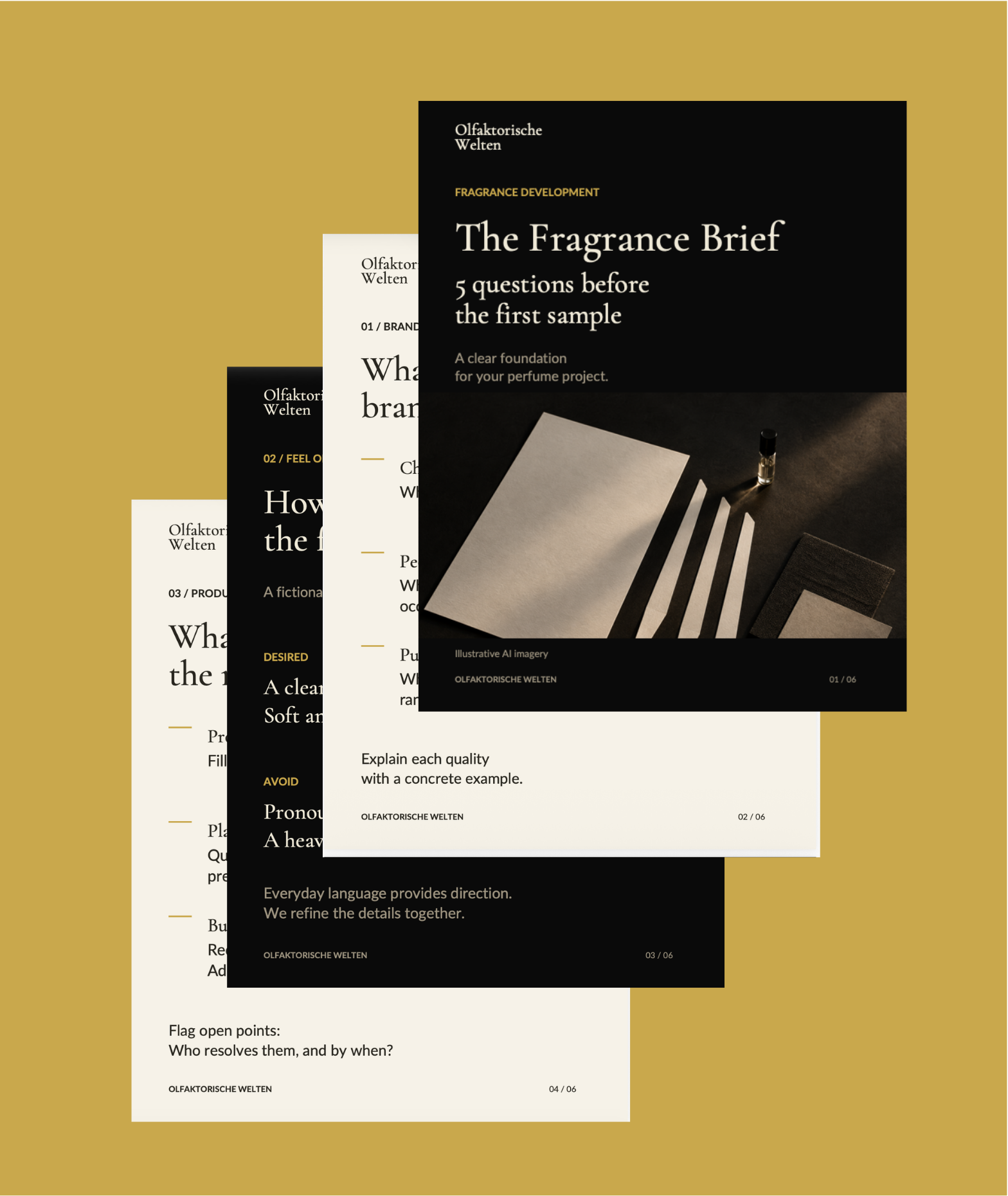
A fragrance brief describes the brand and people a perfume is being developed for, how it should feel when worn, and the practical framework of the project. It connects the creative direction with information about the product, quantity, budget, target market and timeline. You do not need a perfumer’s vocabulary. What matters is that your wishes are clear and that the team can later make decisions using shared criteria.
Below you will find a copyable template and a completely fictional example for a fashion brand. Both help you organise existing ideas and make open questions visible before the development discussion.
Start with the brand and its audience
“Premium and unique” does not yet describe a clear fragrance direction. Explain what such terms mean for your brand: minimalist design, expressive colours, soft materials or an energetic everyday voice? Choose a small number of attributes and illustrate each one with a concrete example.
Next, describe the people who should buy and wear the perfume. Use all the information your brand already has, such as personas, age, income, style, use case and purchasing context. Are they looking for an everyday companion, a product for special occasions or a gift? Should the perfume complement an existing collection or stand as a product in its own right? Mark assumptions that are not yet supported by customer data.
Images and descriptions of materials can clarify your intention. State which quality matters in each case. A photograph of fabric may represent softness; it does not prescribe a particular fragrance material.
Describe the desired wearing experience
Imagine a specific situation. The fragrance is applied before work in the morning, accompanies a free afternoon or belongs to an evening out. What level of presence fits that moment? Should it remain intimate and understated, or be clearly noticeable?
Describe the development over time as well: what first impression do you want, and what should remain on the skin later? At this stage these are goals to be discussed through samples. They are not yet a promise of a particular longevity or intensity.
State what you want to avoid. “Warm, but without pronounced sweetness” is more useful than “pleasant”. If wishes compete, set a priority: is bright freshness more important, or the soft overall effect?
Use everyday language and explain references
Words such as bright, dry, soft, green, powdery or spicy can provide a starting point. Your explanation matters because different people may understand the same word differently. A sentence such as “By fresh, we mean a clear, airy impression without pronounced sweetness” gives the discussion direction.
Fragrance references can help in a confidential development conversation. Describe exactly what you like and what should change: the opening impression, the warmth as it develops or the understated presence. A reference is a communication aid for defining your own direction. A list of popular perfumes does not replace a brand brief.
Learn how Olfaktorische Welten supports briefing, partner selection, evaluation and revision on our page about bespoke fragrance development.
Define the type of fragrance development
Clarify how the new fragrance should relate to an existing reference. Should it smell as close as possible to a model (imitation), take inspiration from it and develop the idea with slight changes (variation), or be created as a fully original fragrance (creation)? Include this classification explicitly because it defines the task for the next stages.
If you use a reference, identify the single aspect that matters to you. For an original creation, images, materials, situations and moods can communicate the intended effect without making an existing fragrance the target.
Include the product and practical parameters
The brief should also cover product format, fill volume, concentration and ideas for the bottle, closure and packaging. Mark which components are already fixed and which you would like to select together. Any design preference must subsequently be checked for technical suitability and availability.
Separate the desired retail price from the project budget. The retail price defines the intended positioning of the finished product; the budget sets the financial framework for implementation. For both figures, state what they refer to and whether they include or exclude tax. For the budget, specify whether it should include development, components, manufacturing, packaging and logistics. If no amount has been agreed yet, record this as an open decision.
Add the initial quantity, target markets and sales channels. The confirmed minimum order quantity at Olfaktorische Welten is 500 units. Suitable variants, sizes and specifications—and how the quantity can be allocated—are clarified for each project. Manufacturing takes place in Germany with partners selected according to the project. Learn more about the transition from development to implementation under perfume manufacturing in Germany.
A desired launch date also belongs in the brief. Distinguish a fixed occasion from a flexible target date. Components, unresolved decisions and internal approvals must be considered in the subsequent timeline. A briefing date alone is not a confirmed delivery commitment.
Agree how samples will be evaluated
Before the first evaluation, decide who provides feedback, who consolidates it and who makes the final decision. Select a small number of priority criteria from the brief. This enables the team to discuss personal preferences separately from the desired brand fit.
Record the sample code, date, first impression and later development. Agree on a shared process so that feedback remains traceable. First describe what you perceive, then explain how it relates to the brief. “Too sweet for the desired dry character” indicates a direction; “I don’t like it” leaves the direction unclear.
Resolve conflicting requests before commissioning a change. If one person wants more freshness and another more warmth, a priority is needed. Record any changes to the brief as well. Otherwise, a sample may be judged against expectations that were not part of the original assignment.
Your copyable fragrance brief template
Fragrance brief for your perfume project
This template connects your brand idea with the product requirements. Complete the fields in your own words. Open questions are welcome: assign an owner and a date for clarification.
01 Brand and assignment
Project and contact
Project name, contact person, date and version number.
Your answer:
Brand world
Describe your brand using three attributes, ideally with an example for each. Add references to images, websites, competitors and other relevant material.
Your answer:
Target audience
Provide all available information about who should buy the perfume: personas, age, income and other relevant characteristics.
Your answer:
Role for your brand
What role should the perfume play for your brand?
Your answer:
02 Fragrance idea and character
Describe effects, situations, types of person, moods and occasions. Technical terms are not required. If you use a reference, explain the single aspect that matters to you.
Desired effect and presence
How should the fragrance be perceived? How present should it be?
Your answer:
Typical wearing situation
For example, everyday life, the office, evening wear or a particular occasion.
Your answer:
Desired and undesired impressions
Which impressions fit the brand? What should be avoided?
Your answer:
References
Fragrance, image or material: We are interested in … / We would like this to be different …
Your answer:
03 Product and framework
Separate fixed requirements from preferences. The retail price is different from the available project budget. Mark assumptions and specify what each figure includes.
Product and specifications
Product format, fill volume, concentration, bottle, closure and packaging. What has already been decided?
Your answer:
Type of fragrance development
Should the fragrance follow a reference as closely as possible (imitation), take inspiration from an existing fragrance with slight changes (variation), or be developed as a fully original fragrance (creation)?
Your answer:
Quantity and distribution
Number of units, target markets and sales channels, such as your own stores, direct retail sales or distribution.
Your answer:
Target retail price
Desired retail price, currency and price basis.
Your answer:
Project budget
Budget range, currency and included services, such as development, product and packaging.
Your answer:
Timeline
Desired launch, fixed deadlines and available flexibility.
Your answer:
04 Evaluation and decision
Agree how feedback will be collected. For each sample, record its code, date, opening impression and later development. Document the next shared decision.
Evaluation criteria
Three to five criteria from the brief, such as brand fit, effect and wearing situation.
Your answer:
Participants and decision
Who evaluates? Who consolidates feedback? Who makes the final decision?
Your answer:
Next review
Date, required documents and expected decision.
Your answer:
Open questions
For each question: responsible person, clarification date and next step.
Your answer:
Discuss your fragrance brief with us
team@olfaktorische-welten.com
Fictional example for a minimalist fashion brand
This example is entirely fictional. It describes neither a client nor a completed Olfaktorische Welten project. All details serve only to illustrate the template; they are not an offer or a feasibility commitment.
01 Brand and assignment
Project and contact: The project is called “First Wearable Brand Fragrance”. A fictional product manager leads the briefing. The date and version number are added to every draft.
Brand world: Three attributes describe the fictional brand: clear stands for reduced forms, warm for pleasant materials and an approachable tone, and understated for few visible details. A mood board of neutral fabrics and colours illustrates the brand world.
Target audience: The fictional persona is a design-conscious professional aged 30 to 45 with a medium to high disposable income. This person buys a small number of clothes deliberately and is looking for an understated everyday perfume. This definition is an assumption for the example and would need to be compared with available customer data in a real project.
Role for the brand: The perfume should complement the clothing range as a product in its own right and make the minimalist, warm brand world wearable.
02 Fragrance idea and character
Desired effect and presence: The opening should feel bright and clear; the later impression should be soft and warm. The fragrance should be noticeable at close range without filling a room. These are development goals, not measured properties.
Typical wearing situation: An everyday and office fragrance.
Desired and undesired impressions: A dry, soft woody impression with bright, low-sweetness freshness is desired. A strongly sugary or heavy effect should be avoided. If “bright” and “warm” cannot be combined as intended in the sample, the warm, understated overall effect takes priority.
References: A mood board with light fabrics and warm woods serves as the visual and material reference. No existing perfume brands are named.
03 Product and framework
Product and specifications: The current idea is a wearable perfume in one size and initially one fragrance variant. Fill volume and concentration remain open. A clear standard bottle with understated labelling and a coordinated closure should be assessed. Specific components and packaging have not yet been selected; availability and technical suitability must be discussed.
Type of fragrance development: The fictional brand wants a creation—a fully original development. The visual and material references describe the intended effect and are not fragrance models.
Quantity and distribution: The initial quantity remains open. Germany is the first planned target market. Sales should take place through the brand’s online shop and its own stores.
Target retail price: The target retail price remains open. The product manager will agree the currency and price basis with sales and management.
Project budget: The project budget remains open. Before product selection, the team will clarify which development, product and packaging services should be included.
Timeline: The desired launch is alongside a future collection. No date has been set. Components, budget and the approval process will be aligned first; a realistic schedule will then be developed with the project partner.
04 Evaluation and decision
Evaluation criteria: The criteria are a clear opening impression, a soft and warm development, and understated presence.
Participants and decision: The product manager and marketing evaluate the same samples. The product manager consolidates the feedback; management makes the final decision.
Next review: The completed brief, mood board and internally agreed budget range are required. The team will then decide the direction for the first sample development.
Open questions: Fill volume, concentration, initial quantity, target retail price, project budget and launch date remain open. An owner, a clarification date and the next step are recorded for each point.
An equally fictional sample comment demonstrates the desired precision: “Sample B fits the brand world with its soft impression. The opening still feels too sweet to us. Please reduce this sweetness while retaining the soft overall effect.” The sample code, date, opening impression and later development would also be recorded.
Frequently asked questions about fragrance briefs
Do I need specialist vocabulary?
No. Describe impressions, situations and preferences in your own words. Explain terms that people may interpret differently. Translating your language into a concrete development direction is part of the collaboration.
May I use other perfumes as references?
You can discuss references in a confidential conversation. State the individual quality you mean. Also specify whether you want an imitation, a variation or a fully original creation. Names of existing clients or production partners are not required publicly.
What can remain open at the beginning?
You do not need to arrive with a finished fragrance formula or final product specification. Quantity, budget and timing may initially be marked as open or as preferences. What matters is that these points are addressed early and that an agreed framework exists before binding decisions are made.
Discuss your fragrance brief with us
Olfaktorische Welten supports brands from the fragrance brief and scent development through the coordination of manufacturing, filling and packaging. Send your completed template or an initial project outline to team@olfaktorische-welten.com. Useful information includes the brand, target audience, product, quantity, target market, budget and desired timeline—with open points clearly marked.
For an anonymous view of our project experience, visit Perfume Projects and References. Additional references are available on request while respecting confidentiality.