
Five decisions for your brand perfume
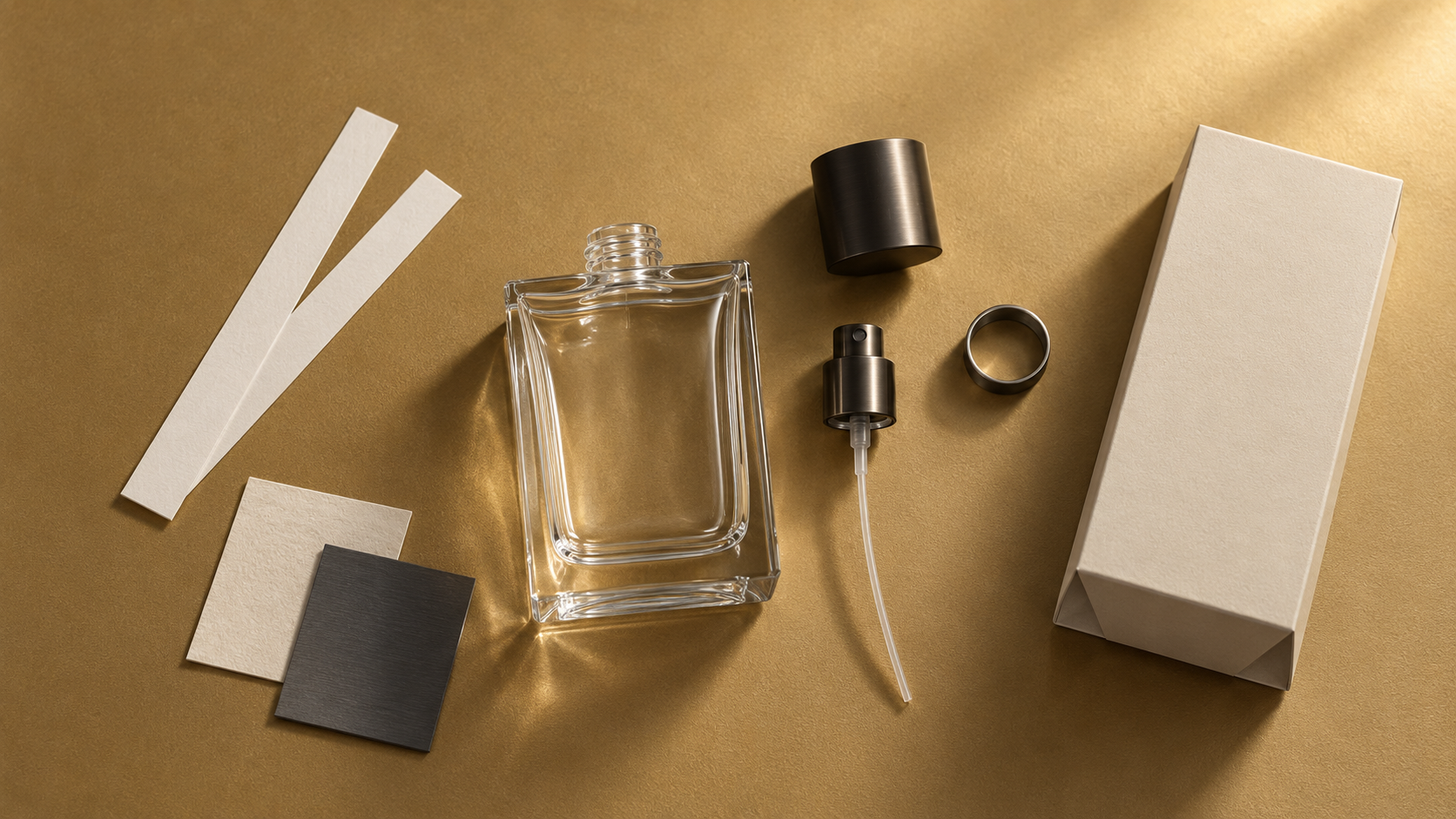
A brand perfume is not created by assembling a series of attractive individual parts. The fragrance, bottle, atomiser, cap, decoration and packaging must express the same product idea while also fitting the intended use, sales channel, quantity and budget.
After the fragrance brief, the next step is therefore not a free choice from a catalogue. The real question is: Which product decisions genuinely shape this brand, and where is an available standard solution the better choice?
The objective is not the most elaborate specification. It is a combination that feels coherent in the intended market position, works technically and remains economically realistic.
1. What role does the fragrance play?
The fragrance is the core of the product, but it does not stand apart from the overall concept. A subtle everyday scent sets different expectations for presence and dosage from an expressive product for special occasions. The desired effect influences the development, the later evaluation and the question of which concentration may suit the wearing experience.
Concentration should not be treated as a quality ranking. More fragrance oil does not automatically make a better product. What matters is how the formula, desired presence, use and price position work together. A designation such as Eau de Parfum does not replace sample evaluation or a project-specific review of the final formula.
Start by recording the effect that is essential for the brand. Then use samples to assess which concentration and dosage support that objective. This keeps the decision tied to the wearing experience instead of turning it into an abstract percentage discussion.
2. What role do the bottle and fill size play?
The bottle shapes the first impression and everyday use. Its form, weight, glass distribution and fill size affect handling, transport, presentation and product cost. A custom shape can create strong distinctiveness. It can also increase tooling costs, minimum quantities, development time and dependencies.
A standard bottle is not automatically generic. Colour, printing, coating, labels, the cap and the folding carton can create a clear brand expression without immediately requiring custom glass tooling. For a first production run, it can be sensible to concentrate individuality in a few highly visible elements.
The neck finish is also part of the decision. FEA 15 is a widely used standard crimp neck finish for spray bottles. The underlying EN 14854 standard defines dimensions for this type of glass container finish. That broadens the range of possible components, but it does not guarantee that every pump, collar and cap will work together.
The bottle, atomiser, collar and cap are therefore sampled as a system. Fit, dip tube, spray pattern, leakage, assembly and compatibility with the filling process must be checked for the specific combination.
3. Should the pump be crimped or the bottle refillable?
With a crimp neck, the pump is permanently crimped onto the bottle. This is an established solution for perfume atomisers, but it is not a refillable screw connection. A refillable bottle needs a suitable screw or refill system and must be coordinated early with the bottle, pump, cap and filling process.
This decision cannot later be corrected by choosing a different cap. It affects the connection between several components and potentially the filling and closing equipment. It therefore belongs in product planning before bottles or pumps are ordered.
Details remain important even within a standard. An overcap may fit one pump but interfere with an additional collar. Unusual materials or forms may require tighter tolerances. A single sample component is therefore not sufficient for technical approval; the complete set is what matters.
4. Where does finishing create real brand value?
Coating, screen printing, hot foil, labels, surface treatments or a decorative element can give the product its own language. Each additional finish should nevertheless have a clear function: it makes a colour recognisable, translates a material world or supports the perceived value at the chosen point of sale.
The question is not: “What else can we add?” A more useful question is: Which detail would be missing if we removed it? If the answer remains unclear, the element may be decoration without sufficient priority.
Finishing also introduces technical dependencies. Surface area, glass form, material, colour effect and durability must be sampled. A colour on paper may look different on glass. A process that makes sense for a large run may sit outside the budget for a smaller quantity. Effect, feasibility and cost should therefore be evaluated together.
5. What must the packaging achieve in the chosen channel?
The folding carton protects, informs and presents the product. Its job depends on the sales channel. In the brand’s own online shop, it must withstand shipping and make sense when opened. In physical retail, it carries mandatory information, supports orientation on the shelf and must work with the tester and point-of-sale presentation. Distribution may introduce further requirements for labelling, outer packaging or logistics.
Here too, a complex construction is not automatically better. Material, printing, inserts and finishing should support the product’s role. A calm, precise pack can be more effective than a solution with several competing effects.
Packaging is also part of subsequent market readiness. Mandatory information and technical areas should not be sought only after the design is complete. The next guide step on market readiness explains which documents, responsibilities and labels are needed before sale.
Three conflicts that should become visible early
Specification versus budget and quantity
A distinctive bottle, an elaborate cap and several finishes may each be reasonable. Together, however, they can quickly exceed the limits of a smaller production run. Prioritise the elements that carry the brand idea most strongly. The perfume calculator helps compare specification scenarios economically. This article does not determine the cheapest route; it shows which design decisions should enter the comparison first.
One fragrance versus a line maintained over time
Many projects initially focus on bringing one fragrance to market. A brand should still take a longer view. Could a later variant, an occasion product or a line for different target groups be relevant? Which elements should remain recognisable, and which may change?
A line must be maintained beyond its introduction. This does not mean launching several fragrances at once. It means planning the first fragrance so later decisions are not unnecessarily blocked and making clear who will continue to develop the range internally.
Custom solution versus compatible standards
A custom form can offer the greatest design freedom. A standard solution may be available more quickly, easier to sample and linked to a broader supplier base. The right choice depends on where the brand genuinely needs differentiation and which effort it can support over time.
Decision matrix
Complete the table first with working assumptions. “Open” is a valid answer when it is also clear who will resolve the question and by when.
Scroll sideways to read the table.
| Decision | Function for brand and use | Link to price and sales channel | Status and changeability | Next evidence |
|---|---|---|---|---|
| Fragrance and concentration | Which effect and presence are essential? | Does the solution fit the position and intended use? | open / sample comparison / provisionally selected | evaluated fragrance samples and documented priority |
| Bottle and fill size | Which form and handling support the product idea? | Does the size fit the channel, price and shipping model? | review standard / review custom / committed | component quotation and physical sample |
| Pump, neck and cap | What use and refill requirement apply? | Does the system fit filling and the sales channel? | changeable early / costly after ordering | complete, technically checked component set |
| Finishing | Which detail creates recognisable brand expression? | Is it sensible at the intended quantity and target price? | concept / colour sample / approved | real finish sample on the target material |
| Packaging | What must it protect, explain and present? | Which requirements come from the channel? | structure open / artwork / produced | white sample, final mandatory areas and print approval |
What remains changeable, and when?
Fragrance and design directions, standard components, fill sizes and finishing or packaging options can be compared relatively easily at an early stage. This is when differences should be made visible and priorities recorded.
Changes become expensive once tooling has been commissioned, components ordered, the neck and pump fixed, finishes produced or regulatory documents aligned to an approved product version. A late correction then affects not only one part but often several suppliers and documents.
Olfaktorische Welten coordinates fragrance and concentration, bottles, atomisers, caps, finishing, packaging, sets and custom solutions on a project basis. Thorsten Biehl brings more than 20 years of experience in perfume contract manufacturing. Which combination is appropriate and available for a project is decided according to quantity, budget, target market, sales channel and technical review.
Frequently asked questions about product decisions
Does a brand perfume need a custom-developed bottle?
No. A standard bottle can achieve a distinctive result through a suitable combination of colour, finishing, cap and packaging. A custom form is an option when its additional value justifies the tooling, quantity and development effort.
Does FEA 15 mean that all components will automatically fit?
No. The standard defines important neck dimensions. The specific combination of bottle, pump, collar, cap and dip tube must still be sampled together and approved for filling and use.
Must a future fragrance line already be fully defined?
No. The first fragrance needs a clear role. It is nevertheless helpful to understand which elements should remain recognisable later and who will maintain the line after launch.
Which product solution supports your brand idea?
Send us your fragrance brief and the product decisions that remain open. Together, we can identify which variants should be sampled, costed or technically checked before commissioning. Write to team@olfaktorische-welten.com.