
Launching a perfume line: which launch components does your sales channel need?
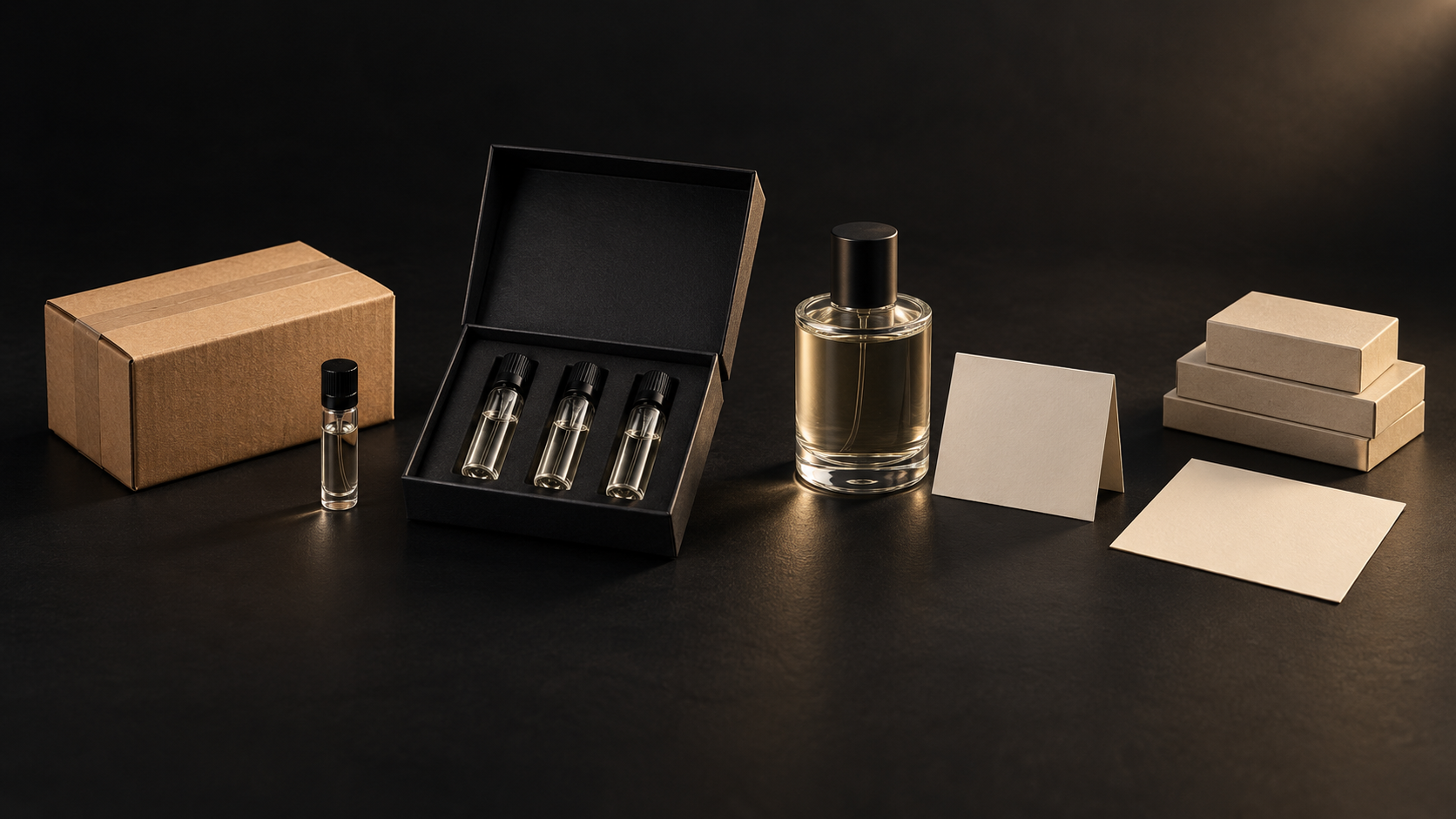
A perfume that is ready for sale still needs a route to the customer. Whether that calls for a mailed sample, a discovery set, a tester in store or retailer information is not determined by a generic launch checklist. It is determined by the sales channel.
The central question is therefore: How can people test, understand and buy the fragrance in the chosen channel, and which observations can support the brand’s next decision?
An online shop needs different components from a brand-owned retail space, an external retailer or a distributor. Clarifying these differences before launch helps avoid producing material that has no purpose at the actual point of sale.
Define the launch channel first
The preferred sales route should already have been named in the project mandate. For the launch, that decision becomes concrete:
- Where will the target group first encounter the product?
- Can people test the fragrance there directly?
- Who explains the product idea and its use?
- Who keeps samples, testers and stock available?
- Where are feedback and sales data generated?
- Who decides on a reorder or adjustment?
“Launch everywhere” is rarely a sufficient plan. Different channels require different handovers, materials and stock. A clear launch channel shows which components must work first and what can be added later.
Own online shop: bridge the distance to the fragrance
In an online shop, the fragrance cannot be experienced directly before purchase. The product page must therefore explain clearly who the product is for and in which situations it is intended to be worn. Sampling can reduce that distance.
Possible components include an individual sample, a mailed sample or a discovery set containing several variants. A discovery set is not an automatic requirement. It makes sense when the brand can genuinely offer several fragrances for comparison or when structured discovery is part of the sales model. For a single fragrance, one targeted sample may be the clearer route.
Traditional point-of-sale material is generally unnecessary in a purely online channel. More important are clear product presentation, a workable shipping process, a defined feedback route and a connection between sampling and later purchase where that can be observed technically and in compliance with data-protection requirements.
Brand-owned retail: make testing and explanation possible
In a brand-owned retail space, the fragrance can be experienced immediately. Sales stock alone is not enough at launch. Testers must be available on time, function properly and be used in the right place.
Depending on the space and range, scent strips, a concise selling aid, a product card or other point-of-sale elements may be useful. Their purpose is not to display as much material as possible. They should provide orientation and help the sales team give a clear explanation that fits the brand.
Also decide who replaces testers, monitors stock and collects feedback. An empty tester or unavailable product is not a communication problem; it is an operational signal.
External retail: make the partner operational
An external retailer does not automatically know the product as well as the project team. It needs the information and materials that are relevant to its sales environment. These may include sufficient testers and samples, a concise product document and suitable point-of-sale support.
The scope depends on the store, space, range and commercial arrangement. Not every retailer needs the same setup. Before launch, clarify:
- Which materials are accepted and will actually be used?
- Who supplies testers and replacements?
- Which product information does the sales team receive?
- How are stock, sell-through and feedback reported?
- Who triggers a reorder?
Producing a point-of-sale solution does not create visibility if its placement has not been agreed. Conversely, a small, precise setup may be enough when the sales point and responsibilities are clear.
Distribution: define handovers and data routes
A launch through distributors adds further handovers. Stock, testers, samples, product information and any materials for downstream retailers must be coordinated in quantity and timing.
The brand should ask not only what is delivered to the distributor. It is equally important to know which information comes back: available stock, orders, sell-through reports, retailer feedback and demand for replacement material. The scope and frequency of data are agreed with each partner; they are not the same in every distribution model.
A modular system for the chosen sales channel
Select only the modules that have a function in the specific launch model. The table is not a mandatory checklist or a fixed offer.
Scroll sideways to read the table.
| Sales channel | Sampling | Selling support | Handover and stock | Useful first observation |
|---|---|---|---|---|
| Own online shop | individual sample, mailed sample or suitable discovery set | product page, intended use and understandable fragrance description | shipping readiness, available stock, defined reorder point | samples issued, purchases in a defined period, feedback, reasons for returns |
| Brand-owned retail | tester, scent strips and, where useful, samples | concise product card or channel-appropriate point-of-sale material | tester replacement, stock, responsibility within the team | tester condition, sell-through, qualitative customer questions, stock gaps |
| External retail | agreed tester and sample quantity | retailer information and accepted point-of-sale support | handover, placement, replacement and ordering route | retailer feedback, reported sell-through, available stock, reorders |
| Distribution | channel-specific testers and samples | coordinated launch documents for distribution and retail | responsibilities, data route and reorder process | orders and stock by channel, feedback, demand for material or product |
Olfaktorische Welten has implemented or coordinated these routes in different projects: individual samples and mailed sampling, discovery sets, testers and point-of-sale materials in retail, launches through distributors, repeat production and extensions of existing fragrance lines. Which modules are required in a specific project depends on the brand, product, market, partners and distribution system.
Check operational readiness before launch
A launch date alone does not show that a sales channel is ready. Review a small number of concrete handovers instead:
- Sales stock is available in the agreed quantity and product configuration.
- The samples, testers and documents needed for the channel are at the point of use.
- Responsibilities for explanation, replacement, stock and feedback are assigned.
- Ordering and reordering routes have been tested or described unambiguously.
- A few observation measures have a time period, data source and owner.
The lead time required is project-specific. Components, production slots, transport, approvals and partner responses can change the schedule. A faster route may cost more and depends on prompt client decisions and approvals.
Sales figures are signals, not proof of effect
Sell-through, samples issued and reorders are useful observations. A single figure does not explain why a product was or was not purchased. It proves neither brand effect nor customer loyalty.
Each observation needs context:
- Which period and channel are being considered?
- Was the product continuously available?
- Could people actually test the fragrance?
- Which variants, sizes or sales locations are being compared?
- What support was available at the point of sale?
- Are there qualitative comments, returns or recurring questions?
A sample-to-purchase observation is meaningful only when the connection can be made reliably. Without a clear technical link, sample volume and later purchases should be considered separately rather than presented as an assumed conversion rate.
Reorder, adjust or continue observing
A reorder should not be triggered solely because the first production run started well. Consider together:
- current and committed stock
- sell-through in the relevant period and channel
- agreed replenishment lead time
- open retailer or distributor orders
- working capital and minimum quantities
- planned product or packaging changes
The outcome may be an unchanged repeat production. It may also be more useful to replenish testers first, improve product presentation, equip a channel differently or wait for further information.
For brand perfumes, the task does not end with the first fragrance. A line must be maintained, refreshed and, where appropriate, extended over time. That does not mean producing several variants immediately. It means bringing feedback, assortment and brand strategy together regularly and making a deliberate decision on whether an extension, for example for another occasion or an additional target group, strengthens the line.
Launch and learning loop
Scroll sideways to read the table.
| Question | Decision before launch | Observation after launch | Next decision |
|---|---|---|---|
| Where does the product launch? | channel, sales locations and reachable target group | actual availability by location or channel | continue, add or limit the channel |
| How is the fragrance tested? | sample, discovery set, tester or combination | issue, use, condition and feedback | adjust sampling quantity or format |
| How is it explained? | product page, selling aid, training or retailer information | recurring questions and points of confusion | improve presentation or handover |
| How is stock observed? | data source, frequency and responsible person | sell-through, remaining stock, orders and gaps | reorder, change quantity or continue observing |
| How is the line maintained? | responsible person and review rhythm | feedback by variant, size and occasion | continue unchanged, refresh, extend or stop |
Frequently asked questions about launch
Does every sales channel need point-of-sale material?
No. A purely online shop does not need traditional point-of-sale material. A suitable selling aid may be important in physical retail. What matters is the purpose the material serves at the specific point of sale.
Is a discovery set always better than an individual sample?
No. A discovery set is useful when several fragrances or variants should be compared in a structured way. For one fragrance, a targeted individual sample may be simpler and clearer.
Does strong sell-through prove an effect on the brand?
No. Sales figures are operational signals. Without a comparison period, availability, channel and additional feedback, they explain neither cause nor long-term brand effect.
When should a reorder be placed?
When sell-through, available stock, open orders, replenishment time, minimum quantity and working capital together support a sound decision. One fixed formula will not fit every product and channel.
Which launch components does your sales channel need?
Tell us about the product, target group and planned launch channel. We can identify which forms of sampling, testers, point-of-sale support, handovers and reorder logic should be reviewed for your project. Write to team@olfaktorische-welten.com.