
What Does a Custom Perfume Cost? The Calculator Shows Which Decisions Matter
Did you know? Two perfumes with the same fill size and retail price can have very different commercial results. The sales channel changes net revenue. A special cap or elaborate finish changes product cost. One-off expenses affect the first production run differently from an unchanged repeat run.
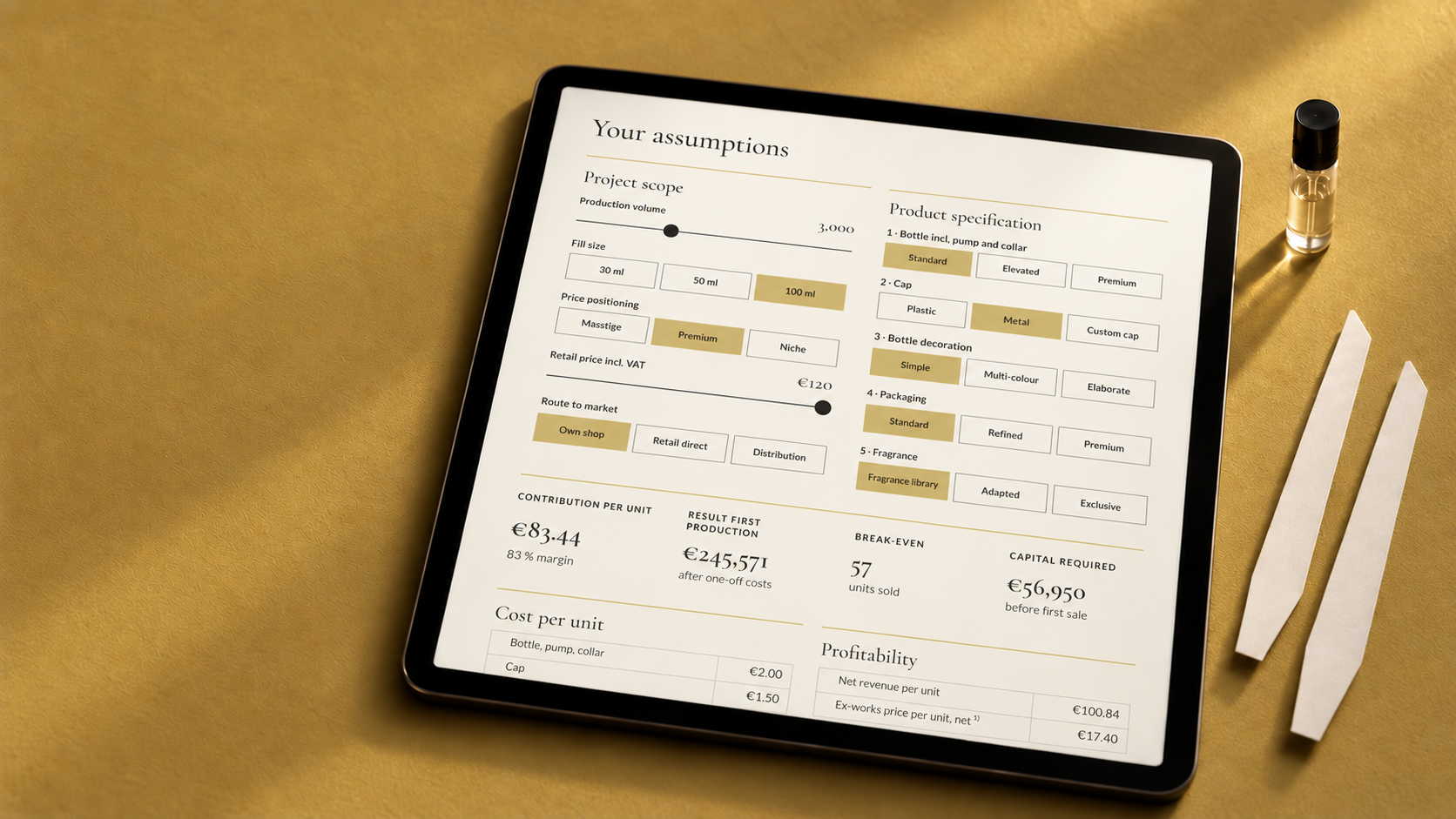
A flat price conceals these relationships. With the Olfaktorische Welten perfume calculator, you can test different assumptions yourself. It shows how quantity, fill size, price positioning, distribution and product components affect contribution margin, the project result and capital required.
The calculator starts with your assumptions
The calculator does not ask for a finished product specification. It establishes an initial commercial framework. Choose a production quantity and fill size, then set price positioning, consumer price and sales channel. Different levels are available for the bottle, cap, decoration, packaging and fragrance.
These inputs form a scenario. The calculator shows, among other things, manufacturing cost and net revenue per unit, possible contribution margin, one-off project costs, the result of the first production run, calculated break-even and capital required before sales begin.
The figures do not tell you which product fits your brand. They show which commercial decisions belong together. That is their value when comparing ideas early in a project.
Did you know? The sales channel changes the calculation considerably
A consumer price reveals little about the amount that reaches the brand. Your own online shop, direct retail and distribution have different revenue structures. Depending on the channel, there may also be costs for payment processing, platforms, shipping, storage or returns.
Try the same fragrance at the same consumer price across different sales channels in the calculator. Keep the product components unchanged. You can then see the effect the channel alone may have on contribution margin and the project result.
This exercise also helps with range planning. Product components that seem viable in direct sales may require a higher retail price or a different cost structure through another channel.
Did you know? Product design affects unit and one-off costs
Commercially, a perfume consists of more than the fragrance and bottle. Cap, decoration and packaging can shape its character. They also change the numbers.
Some choices affect every unit produced. Others mainly create one-off expenses, such as tooling, print preparation or preparing a custom solution. Both types of cost come together in the first production run. In an unchanged repeat run, some one-off costs may no longer apply.
The calculator separates these levels. Compare two variants: what happens if the cap is simpler? How does more elaborate packaging affect capital required? How much room does a different finish create?
The aim is not to find the cheapest components. The calculation helps show which design might fit the planned price and sales channel.
Did you know? Retail price and project result are different figures
Retail price is the most visible number on a product. For feasibility, what matters is what remains after VAT, distribution and product costs. Only then can you assess whether the possible contribution margin could cover the one-off costs of the first production run.
The calculator presents these figures together. You can see how many units would have to sell under your assumptions to reach calculated break-even. It also shows how much capital may be needed before the first sale.
This is particularly useful when you have several variants in mind. A higher retail price may create room; more elaborate components can reduce it again. The calculator makes these relationships visible without treating them as a sales forecast.
How to compare your scenarios
Start with the variant closest to your current product idea. Note or copy its configuration. Then change just one assumption at a time so that you can see which decision changed the result.
Four useful starting comparisons are:
- The same retail price across different sales channels.
- The same components at different price positions.
- A simpler and a more elaborate product design.
- Different quantities with all other assumptions unchanged.
Use the results as a basis for discussion. Mark which assumptions are fixed and where you still have room to choose. A saved configuration is more useful than asking for a flat bottle price because it connects product, market and commercial framework.
What the calculation deliberately leaves out
The calculator covers perfume manufacturing and selected one-off project costs. It does not include every expense a brand may incur. Marketing, advertising, storage and logistics, sampling, returns, and payment and platform fees may affect the result further.
Demand is also an assumption. A calculated break-even does not predict whether or how quickly the necessary quantity will sell. The figures therefore replace neither your own sales planning nor a project-specific quotation.
The calculator does not set a delivery time. Components are sourced for each project, and stock of product materials is not initially included in project costs. Availability, the supply chain and approvals affect the schedule. An accelerated route may cost more and requires feedback and approvals from the client within 48 hours. A specific timeline can only be assessed for the individual project; it is not promised as a standard.
Try your own assumptions now
Open the perfume calculator and work through at least two variants. Compare more than manufacturing cost per unit: look at contribution margin, one-off costs, break-even and capital required.
If a scenario fits your brand, copy the configuration and use it for the next conversation. Olfaktorische Welten supports individual perfume projects from the brief and fragrance development through coordination of manufacturing, filling and packaging. For a project-specific assessment, write to team@olfaktorische-welten.com.
Compare your perfume scenarios
Test your assumptions in the calculator, then share the configuration that best fits your brand for a project-specific conversation.
Open the perfume calculator